 The
growth of a tiny baby inside a mother's womb is like the foundation of a building. The diet of the mother during the 9 months of pregnancy directly affects the foundation of a new human life. So young mothers to be must take great care and proper advice to make sure your diet is healthy and nutritious for your baby. The
growth of a tiny baby inside a mother's womb is like the foundation of a building. The diet of the mother during the 9 months of pregnancy directly affects the foundation of a new human life. So young mothers to be must take great care and proper advice to make sure your diet is healthy and nutritious for your baby.
As new cells, tissues and bones are being formed all the time, the most important nutrients that must be supplied and that are required in excess are protein, vitamins (specially B) and minerals. (Especially calcium and iron).
Milk / Curds is one of the most important foods to be consumed as it is a rich source of protein, vitamin A and D and Calcium. Those who eat egg may eat one egg daily during pregnancy. Chicken and fish too may be eaten in small quantities and preferably at lunch, as they may be difficult to digest. Restrict mutton, beef, etc. as they are too fatty. For a good iron intake, never skip a meal, try to ensure dhal intake at lunch and dinner and make sure you eat whole-wheat chapati's at least once a day, preferably at dinner. Also eat fresh fruits and vegetables daily as their supply of B and C vitamins help the iron absorption.
In the 2nd half of pregnancy, the need for protein and calcium are markedly increased and therefore I would recommend that additional glasses of milk (total 3 glasses) are consumed from the 4th or 5th month. Milk is a rich source of protein and calcium, which are essential for the development of the tissues and bones of the baby growing inside the womb.
Preventing and controlling Nausea and Vomiting
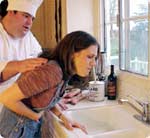 Nausea and vomiting are mainly caused by the changes in the hormones produced during pregnancy. For some it is more severe than for others. It is aggravated by any kind of emptiness in the stomach. As the baby grows your food requirements increase and if this need is not met by regular meals and regular timings of meals, acids build up in the stomach and you feel nauseated. For some this is felt strongly
early in the morning and we advise you to try and eat a couple of biscuits or a small banana even before you get out of bed. Otherwise by the time you start brushing your teeth you may vomit. For some this happens around 6pm if they have not eaten any thing since lunchtime. Please make sure that you eat some biscuits and milk by 4 pm and again have some fruit by 6pm. Nausea and vomiting are mainly caused by the changes in the hormones produced during pregnancy. For some it is more severe than for others. It is aggravated by any kind of emptiness in the stomach. As the baby grows your food requirements increase and if this need is not met by regular meals and regular timings of meals, acids build up in the stomach and you feel nauseated. For some this is felt strongly
early in the morning and we advise you to try and eat a couple of biscuits or a small banana even before you get out of bed. Otherwise by the time you start brushing your teeth you may vomit. For some this happens around 6pm if they have not eaten any thing since lunchtime. Please make sure that you eat some biscuits and milk by 4 pm and again have some fruit by 6pm.
Preventing and controlling Heartburn
During the last trimester when the fetus is growing rapidly, the expanded uterus may press against the stomach, causing contents to return to the esophagus; the burning symptoms may be reduced somewhat with these anti heartburn tips
- Food intake should be divided into 4-6 small meals, which are eaten slowly in a relaxed environment.
- Spicy, high fat, and rich foods, as well as caffeine, alcohol, and individually bothersome
items, are to be avoided.
- Food intake just prior to bed or naptime can cause symptoms.
- Antacids should only be taken if prescribed by the attending physician.
Gestational Diabetes
Those who start a pregnancy already 10,20 or more kgs overweight can become diabetic during pregnancy. Those with family history of diabetes and overweight will be more prone to this. Diabetes in pregnancy endangers the life of the fetus and also can cause hypoglycemia in the new born.
Precautions
Try to reduce weight before you plan a pregnancy. If you get pregnant and you are already overweight you cannot then go on a weight reduction diet. However you may strictly avoid fatty foods and sweets and see that the weight gain is gradual and not in excess.
You may then not need to gain 10kgs but only 6-7 kgs throughout the 9 months.
If you develop diabetes you have to control the diet strictly and maintain fasting blood sugar levels below 100mg/dl. All concentrated sugars and fried food have to be avoided completely. Rice intake should be restricted to once a day preferably at lunch and dry chapatti must be eaten at dinner. Milk must be thoroughly skimmed and use previous days milk for today's intake. Insulin may be required as per doctor's suggestions.
High Blood Pressure
This can be caused by excess weight gain in pregnancy, imbalanced dietary intake and inadequate activity or movement. It is not advisable
to restrict salt severely but food items like chips, mixture, papads, and pickles must be strictly avoided if B.P rises. Weight gain should be controlled and slow walking both morning and evening must be started.
Avoiding caffeine, alcohol, smoking etc
What you shouldn't eat?
 As a category, you should avoid "junk foods" - Potato chips, mixture, vada, bajji etc. Pastries, cookies, chocolates, mitai and other snacks that fill you up without providing nutrition. Occasional snacking isn't harmful, however. You also may find that certain foods make you uncomfortable because they produce gas that presses on the abdomen. Avoid addition of butter and ghee to bread, rice or chapatti. The oil used in regular cooking is sufficient for your body. Fad diets and weight reduction diets like cabbage soup diet,
GM diet, etc should not be followed during pregnancy. As a category, you should avoid "junk foods" - Potato chips, mixture, vada, bajji etc. Pastries, cookies, chocolates, mitai and other snacks that fill you up without providing nutrition. Occasional snacking isn't harmful, however. You also may find that certain foods make you uncomfortable because they produce gas that presses on the abdomen. Avoid addition of butter and ghee to bread, rice or chapatti. The oil used in regular cooking is sufficient for your body. Fad diets and weight reduction diets like cabbage soup diet,
GM diet, etc should not be followed during pregnancy.
Daily Requirements:
Try to ensure that the following are included in your daily menu plan
- 2 Fruits - One at 11 am and one at 6 pm
- 2 Salads - One cup at lunch and one cup at dinner
- 2 Servings Dhal / Pulses -Half to one cup at lunch and at dinner
- 3-4 glasses Milk/Curd - Through out the day as milk, coffee, tea, curds, buttermilk etc.
- 2-3 liters Water- Through out the day
Walking
Regular walking is very good during pregnancy as it improves the circulation and keeps one feeling  healthy and fit. Walking is the safest exercise to take up during all stages of pregnancyAfter the 4th month or so, regular walks are very helpful and I would recommend 20-30 min in the morning and 20 min in the evening too. This improves the circulation and keep the appetite healthy and makes the muscles strong in the legs and hips, which ensures a smooth delivery.Never go for a walk on an empty stomach as it may cause giddiness and result in a fall. However if for any reason the doctor advises you not to walk you have to follow her instructions. healthy and fit. Walking is the safest exercise to take up during all stages of pregnancyAfter the 4th month or so, regular walks are very helpful and I would recommend 20-30 min in the morning and 20 min in the evening too. This improves the circulation and keep the appetite healthy and makes the muscles strong in the legs and hips, which ensures a smooth delivery.Never go for a walk on an empty stomach as it may cause giddiness and result in a fall. However if for any reason the doctor advises you not to walk you have to follow her instructions.
During the last trimester, as the weight increases more rapidly, you may not be able to walk as far as earlier. Do not strain and force yourself to cover the earlier distance. Just try to complete 20 mins. at a moderate pace. But again try to walk both in the morning and evening rather than just once for a long duration, 4-5 km may take 45-60 min on an average and I would say, this could be too much in pregnancy, 20-30 min is safe. Weight gain
The ideal weight gain through 9 months should be between 10 -12 kgs. 1 trimester - (13 weeks) 1.5 - 2kgs
2 trimester - (26 weeks) 4kgs
3 trimester - ( 39 weeks) 4kgs
39 to 40 weeks 10kgs
Note: "Please strictly avoid overeating or eating for 2".
You are eating normally for yourself and a tiny baby not an other adult. |