|
Babies/infants
Importance of mother's milk, growth patterns and the reason behind weaning and introduction of various food groups at different stages of infancy.
Advantages of Breast-feeding
- The first advantage is that the baby is close to the mother, is held close against the mothers body, feels the warmth of the body, gets the smell of the mother and this builds bonding, security and a sense of well-being which is a great booster to the overall growth and development of the baby.
- The mother's milk is in the exact composition and right balance of protein, carbohydrate,
fat, vitamin and minerals for the ideal growth of the baby.
- It is ready made, no making or mixing and is at the exact temperature at which the baby should
drink it.
- It is clean and free of all harmful organisms.
- It contains antibodies that protect the baby from falling ill easily.
- Breast milk develops a degree of protection in the child against the developments of lymph system cancer and diabetes in later years. Breast fed infants are less likely to develop allergies in early life as compared to those
that are formula fed.
- Intelligence, as measured by IQ, tends to be higher in babies receiving breast milk than in those given formula.
SO BREAST IS BEST !
How is it done?
Put the baby to the right breast, allow her to drink for five minutes, burp her. Then put her to your left breast and allow her to drink for as long she wants (10-15 mins). Try not to feed again for at least 2 hrs. This time limit is essential for milk production. If she keeps crying in-between this period, check all other needs, burp her, change the nappy if necessary, play with her, walk her, rock her, and some how postpone the feeding for 2 hours. When it is time for the next feed, start at the left breast for 5 mins, burp and then place at right breast for the longer duration. One more important factor is to ensure that the baby's mouth is properly placed on the areola (brown/pink area around the nipple.) If the mouth is on the nipple the nipple will crack and breast-feeding will be very painful and difficult.
Give me some points on how to wean my baby?
Weaning is the introduction of any food other than the breast milk or bottle feed the baby has been taking from birth and can be done between 3 to 4 months of age.
3rd month
 It is ideal to start with orange juice when the baby is 3 months old. Try and avoid sour oranges and see that it is well diluted, one
part of orange juice to 3 parts of water with a little sugar. Taste it yourself. It should be mild and pleasant to taste. Do remember
that orange juice is not a substitute to milk. As it is mainly water, it should be given between 2 milk feeds. Please use boiled and cooled water and a clean sterile bottle. Musambi (sweet lime) can also be used. It is ideal to start with orange juice when the baby is 3 months old. Try and avoid sour oranges and see that it is well diluted, one
part of orange juice to 3 parts of water with a little sugar. Taste it yourself. It should be mild and pleasant to taste. Do remember
that orange juice is not a substitute to milk. As it is mainly water, it should be given between 2 milk feeds. Please use boiled and cooled water and a clean sterile bottle. Musambi (sweet lime) can also be used.
In the beginning the baby may take 1 - 2 tsp. of it but this can be increased within a week to 50 ml and then to 100 ml. After a month or so the concentration of juice to water can be increased to 1:2 or 1:1. If the child is not showing any revulsion or allergic reaction, it can be given in all seasons. If the weather is cold, use lukewarm water to mix the juice. Hot water will destroy Vit C. One of the Vitamins that milk lacks significantly is Vit C, which is important for healthy growth, resistance to infection and improving iron absorption. Therefore, fruit juice rich in Vit C such as orange, musambi or tomato is usually the first thing to be started for the baby.
Multi vitamin drops like Abdec or Zevit must be given from 4 months to 1 year.
Also expose the child regularly to morning sunlight so that Vitamin D is formed in their body.
4th Month
To meet the increased calorie needs from the 3rd or 4th month a cereal and milk porridge type of preparation is to be started. Rice is the safest choice as it has been seen to be easily accepted by children and not causing any irritation or allergy in babies. One level tsp. of roasted rice powder can be mixed in 100ml-diluted cow's milk and cooked to a gruel or porridge on a slow fire. More milk may be added if it is too thick and sugar for taste. This can be spooned into the baby's mouth little by little. Gradually increase the quantity as per the requirement of the baby.
 If
you would prefer a commercial brand you may go for a rice Cerelac or Nestum. There is no harm in using the so-called commercial foods
like Cerelac, as it is safe, clean and convenient. Follow the instructions and quantities prescribed on the packet or container. Please introduce this as a breakfast feed around 8 or 9 am and continue all other milk feeds. Water must be introduced with the Cerelac feed. Spoon a few teaspoons into the baby's mouth after the feed. When the baby is 4 or 5 months, and can hold up her head, allow her to sip water from a small narrow cup (e.g. The cap of a feeding bottle.) This prevents water from spilling. Avoid water in a feeding bottle. Water must be boiled and cooled. If
you would prefer a commercial brand you may go for a rice Cerelac or Nestum. There is no harm in using the so-called commercial foods
like Cerelac, as it is safe, clean and convenient. Follow the instructions and quantities prescribed on the packet or container. Please introduce this as a breakfast feed around 8 or 9 am and continue all other milk feeds. Water must be introduced with the Cerelac feed. Spoon a few teaspoons into the baby's mouth after the feed. When the baby is 4 or 5 months, and can hold up her head, allow her to sip water from a small narrow cup (e.g. The cap of a feeding bottle.) This prevents water from spilling. Avoid water in a feeding bottle. Water must be boiled and cooled.
5th month
 Mashed banana can be introduced in small quantities when the baby is 5 or 6 months old. Mash thoroughly with a fork. Mashed banana can be introduced in small quantities when the baby is 5 or 6 months old. Mash thoroughly with a fork.
6th Month
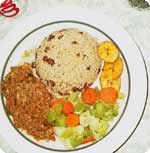 Ragi porridge may be introduced at breakfast instead of the Cerelac. Sieve coarse ragi powder and using the fine powder make a gruel of it with water and milk, add a little sugar or jaggery for taste. A 6-month-old baby is ready for lunch. Over cooked rice with a little dhal and vegetables like potato and carrot can be mashed with a fork. Make it semisolid and start with a couple of teaspoons at lunch everyday (strictly avoid grinding the food in the mixi). At this stage the baby is ready for mashed food. Continue the milk feed at this time soon after the few spoons of rice. As the intake of rice increases, reduce the quantity of milk. Please avoid adding additional ghee or butter to the baby's meal. It is very taxing to the baby's digestive system and should be strictly avoided till 9 months of age. Ragi porridge may be introduced at breakfast instead of the Cerelac. Sieve coarse ragi powder and using the fine powder make a gruel of it with water and milk, add a little sugar or jaggery for taste. A 6-month-old baby is ready for lunch. Over cooked rice with a little dhal and vegetables like potato and carrot can be mashed with a fork. Make it semisolid and start with a couple of teaspoons at lunch everyday (strictly avoid grinding the food in the mixi). At this stage the baby is ready for mashed food. Continue the milk feed at this time soon after the few spoons of rice. As the intake of rice increases, reduce the quantity of milk. Please avoid adding additional ghee or butter to the baby's meal. It is very taxing to the baby's digestive system and should be strictly avoided till 9 months of age.
7th Month
After the 6 month, an evening meal can be started and as Ragi is given in the morning, the Cerelac can be shifted to a 6 or 7 PM feed. After 6 months you may use wheat Cerelac and other variations like vegetable and fruit Cerelacs.
 Fresh
apple, scraped with a spoon can be given before or after dinner from 7 months onwards. It is a waste to stew apple or juice it. Scrape the pulp carefully from a freshly cut apple and give tiny amounts in a spoon. Fresh
apple, scraped with a spoon can be given before or after dinner from 7 months onwards. It is a waste to stew apple or juice it. Scrape the pulp carefully from a freshly cut apple and give tiny amounts in a spoon.
|
|